
co.LAB – A Digital Lab for the co-Design, co-Development and co-Evaluation of Digital Learning Games
Interest in Digital Learning Games (DLGs) has flourished at all levels of education. Digital Learning Games contribute to increasing students’ motivation and engagement, and are effective tools to support learner centered teaching practices. However, the design, development and uses of DLGs remain an issue due to the gap between teachers, game developers and researchers.
At the crossroads between educational and computer sciences the goal of the co.LAB project is to improve the design, development and uses of Digital Learning Games at all educational levels in Switzerland. This goal will be achieved by the development of what we call the co.LAB: a collaborative methodological framework between teachers, game developers and researchers in educational science, associated with a collaborative digital platform dedicated to co-design, co-development and co-evaluation of DLGs.
With the development, implementation and assessment of the co.LAB methodology and digital platform, we want to answer the following research questions (RQ).
RQ1: What methodology is needed to support collaborative DLG design and development?
RQ 2: What are the digital platform features necessary to support the collaborative DLG design and development process?
RQ 3: What are the effects of the methodology and digital platform on development cost and duration (efficiency)?
RQ 4: What are the effects of the methodology and digital platform on the quality of DLGs produced (relevance and effectiveness)?
RQ 5: What are the drivers for adoption of the methodology and digital platform by the educational, game developer, and research communities?
Following a design-based and mixed methodology, the co.LAB methodology and digital platform will be implemented and tested with the design, development and evaluation in real educational contexts of two showcase games dedicated to medical education (higher education) and computational thinking (secondary education). They will be used as a proof of concept. The experimentations will be carried out with classes both in a secondary school and at a university of applied sciences. The data collected will be based on an ethnographic approach on the one hand (questionnaires and focus groups carried out with stakeholders), and on the digital traces of users of the platform on the other hand.
By including a digital infrastructure for digital learning resources development and by providing, as a use test result, two digital learning games the project is fully in line with the PNR77 goals and more specifically with the module “Education, learning and digital change”. In addition, the co.LAB methodology, digital infrastructure and laboratory may serve both as an example of the introduction of digital in education and as a basis for future co-development of open digital educational resources in general.
Durée du projet
01/2020 – 12/2023
Financement
Fonds National Suisse

Requérants principaux
Dominique Jaccard HEIG-VD et Eric Sanchez, Université de Fribourg
Partenariat
Haute Ecole d’Ingénierie et de Gestion du Canton de Vaud
Membres du projet
Estelle Prior Unige
Mariem Jaouadi Unige
Membres associés
Nadine Mandran LIG/U. Grenoble
Matthieu Vermeulen IMT Nord Europe
Emmanuel Beffara U. Grenoble
Gaëlle Guigon IMT Nord Europe
Jérémie Humeau IMT Nord Europe
Anthony Fleury IMT Nord Europe
Contact
Eric Sanchez (eric.sanchez@unifr.ch)
Dernières actualités relatives à cette recherche
Séance personas pour le projet Explora
Le LIP est impliqué dans le projet Explora, une journée portes ouvertes qui, le 22 septembre 2018, permettra de découvrir l’Université de Fribourg. Il s’agit pour l’équipe de concevoir un jeu numérique permettant de comprendre les missions de l’Université et les...
Le LIP aux RJC EIAH 2018
Les septièmes rencontres jeunes chercheurs en EIAH (RJC EIAH 2018) ont été organisées à l’ESPE de Franche-Comté à Besançon du 3 au 5 avril dernier. Ce fut l’occasion pour deux doctorant-e-s du LIP de présenter leur thèse sous la forme de posters, de nouer des contacts...
LudoviaCH, le numérique à l'école au service de l'émancipation des élèves
La première édition de LudoviaCH vient de se terminer et ce fut un beau succès avec près de 500 participants sur les trois journées. Je ne reviendrai pas ci-dessous sur les très intéressantes réalisations qui ont été présentées dans les ExplorCamps et FabCamps, les...
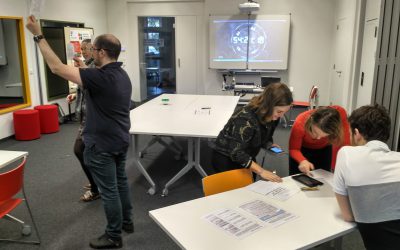
Un Escape Game pour former aux usages éducatifs du numérique
Comment former des étudiant-e-s à l’usage du jeu en contexte éducatif ? En jouant ! C’est en tout cas l’approche que nous avons retenue pour le cours destinés aux futurs enseignants du canton de Fribourg. Ce jeudi matin, au laboratoire d’innovation pédagogique, des...
Pensée computationnelle et didactique : échos du colloque Didapro 7 – DidaSTIC
Le thème de la conférence Didapro 7- DidaSTIC, qui s’est tenue à la Haute École Pédagogique (HEP) du canton de Vaud à Lausanne du 7 au 9 février 2018 était cette année : « de 0 à 1 ou l’heure de l’informatique à l’école ». C'est donc la didactique de l'informatique...

Séminaire du CERF
Les doctorants du CERF présenteront leurs travaux de recherche au LIP le 16 mars 2018. Le prochain séminaire du CERF sera entièrement consacré à la présentation des travaux de thèses qui sont menés au sein de l'équipe. Ainsi, cinq présentations permettront de se faire...
Séminaire du CERF – l'analyse de contenu
Le prochain séminaire du CERF portera sur l'analyse de contenu. Il se tiendra au Laboratoire d'innovation pédagogique le 1er décembre 2017 de 9:00 à 12:15. Programme Questions épistémologiques et méthodologiques, dans l’analyse d’entretiens (Marco Allenbach, HEP...
Première expérimentation du projet PLAY à Sion
Le projet PLAY (Playing for learning, an economic approach to human behavior) vise à comprendre comment le jeu en contexte muséal peut changer l'expérience du visiteur du musée et l'amener à comprendre des problèmes complexes et pluridisciplinaires. Le projet PLAY est...

Projet Classcraft Suisse-Brésil
Le projet Classcraft Suisse-Brésil a été sélectionné par la Leading House for the Latin American Region (Université de Saint Gall) pour un financement qui permettra de conduire une analyse des usages du jeu au Brésil et en Suisse Romande. Le projet sera conduit en...

1er Colloque AUPTIC.education
Le laboratoire d'innovation pédagogique du CERF participera au 1er Colloque AUPTIC.education sous le thème "Les technologies au coeur de la pédagogie" organisé le 23 et 24 novembre prochain à la HEG à Genève. Depuis près de vingt ans, les technologies numériques (TN)...