
co.LAB – A Digital Lab for the co-Design, co-Development and co-Evaluation of Digital Learning Games
Interest in Digital Learning Games (DLGs) has flourished at all levels of education. Digital Learning Games contribute to increasing students’ motivation and engagement, and are effective tools to support learner centered teaching practices. However, the design, development and uses of DLGs remain an issue due to the gap between teachers, game developers and researchers.
At the crossroads between educational and computer sciences the goal of the co.LAB project is to improve the design, development and uses of Digital Learning Games at all educational levels in Switzerland. This goal will be achieved by the development of what we call the co.LAB: a collaborative methodological framework between teachers, game developers and researchers in educational science, associated with a collaborative digital platform dedicated to co-design, co-development and co-evaluation of DLGs.
With the development, implementation and assessment of the co.LAB methodology and digital platform, we want to answer the following research questions (RQ).
RQ1: What methodology is needed to support collaborative DLG design and development?
RQ 2: What are the digital platform features necessary to support the collaborative DLG design and development process?
RQ 3: What are the effects of the methodology and digital platform on development cost and duration (efficiency)?
RQ 4: What are the effects of the methodology and digital platform on the quality of DLGs produced (relevance and effectiveness)?
RQ 5: What are the drivers for adoption of the methodology and digital platform by the educational, game developer, and research communities?
Following a design-based and mixed methodology, the co.LAB methodology and digital platform will be implemented and tested with the design, development and evaluation in real educational contexts of two showcase games dedicated to medical education (higher education) and computational thinking (secondary education). They will be used as a proof of concept. The experimentations will be carried out with classes both in a secondary school and at a university of applied sciences. The data collected will be based on an ethnographic approach on the one hand (questionnaires and focus groups carried out with stakeholders), and on the digital traces of users of the platform on the other hand.
By including a digital infrastructure for digital learning resources development and by providing, as a use test result, two digital learning games the project is fully in line with the PNR77 goals and more specifically with the module “Education, learning and digital change”. In addition, the co.LAB methodology, digital infrastructure and laboratory may serve both as an example of the introduction of digital in education and as a basis for future co-development of open digital educational resources in general.
Durée du projet
01/2020 – 12/2023
Financement
Fonds National Suisse

Requérants principaux
Dominique Jaccard HEIG-VD et Eric Sanchez, Université de Fribourg
Partenariat
Haute Ecole d’Ingénierie et de Gestion du Canton de Vaud
Membres du projet
Estelle Prior Unige
Mariem Jaouadi Unige
Membres associés
Nadine Mandran LIG/U. Grenoble
Matthieu Vermeulen IMT Nord Europe
Emmanuel Beffara U. Grenoble
Gaëlle Guigon IMT Nord Europe
Jérémie Humeau IMT Nord Europe
Anthony Fleury IMT Nord Europe
Contact
Eric Sanchez (eric.sanchez@unifr.ch)
Dernières actualités relatives à cette recherche

Le cyberharcèlement scolaire
Le semestre de printemps 2019 s'est conclu avec la soutenance de mémoire de Victor Francey qui portait sur "Le cyberharcèlement scolaire : Identification et prise en compte par les enseignants des cycles d'orientation du canton de Fribourg". Dans cette vidéo, Victor...
LETS LearningLab Network
Sélectionné pour financement par la Leading House for the Middle East and North Africa et mené en partenariat avec l'Université de Sousse (Tunisie), l'Université D’Alexandrie (Egypte) et Arts, Sciences et Technologie Université à Beyrouth, (Liban), le projet LETS...

Le LIP/CERF recrute un-e assistant-e diplomé-e à 50% pour renforcer son équipe
Le LIP/CERF recrute un-e assistant-e diplômé-e qui pourra consacrer une partie de son temps d'engagement à la réalisation d'une thèse de doctorat. CAHIER DES CHARGES Participation aux activités de recherche du LaboratoireParticipation au suivi et à l’accompagnement de...
Thèse Jam d’été du LIP
Une Jam-session, ou bœuf en français, est, pour des musiciens de jazz, une séance d'improvisation. Une game-jam est une séance dédiée à la conception d'un jeu. Dans le même esprit, une thèse-jam est un atelier organisé pour travailler sur son sujet de thèse. L'équipe...

Retour sur le Congrès TACD – Rennes 2019
La TACD (Théorie de l’Action Conjointe en Didactique) est un cadre théorique basé sur la métaphore du jeu, qui permet d’analyser les transactions (dont les savoirs sont l’objet) entre élèves et enseignants dans la classe (Sensevy, 2011). Du 25 au 27 juin 2019 s’est...
Nouvelle publication
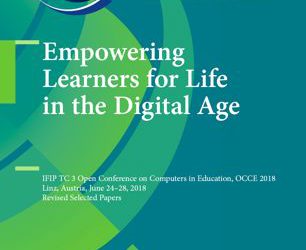
Le LIP a fortement contribué à un nouvel ouvrage publié chez Springer. L'ouvrage, édité en collaboration avec des chercheurs anglais et italiens rassemble des versions révisées d'une sélection de papiers présentés lors de la conférence OCCE 2018 à Linz, Autriche. ....
Retour sur EIAH 2019
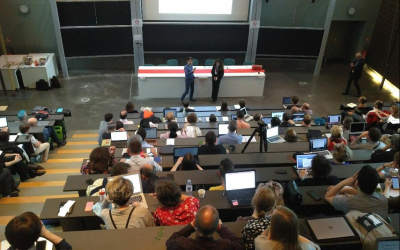
Avec plus de 250 inscrits l'édition 2019 de la conférence Environnements Informatiques pour l'Apprentissage Humain qui s'est déroulée du 4 au 7 juin à Paris a été un succès unanimement souligné par les participants. Cette année, la thématique de la conférence...

Une nouvelle recrue pour le LIP
Dans le cadre d'un partenariat avec la HES-SO du campus universitaire de Fribourg, le LIP accueille Matthieu Vallat pour son stage de Bachelor en informatique. Matthieu travaille en particulier dans le cadre du projet Escape Game santé sur la conception et le...

Après-midi d’échange de l’AFPIT (15.05.2019)
L'après-midi d’échange de l’AFPIT (Association fribourgeoise des professeurs d'informatique & TIC) a eu lieu le mercredi 15 mai 2019 à l’Université de Fribourg. L'objectif annoncé était de susciter des échanges autour de la question de l’enseignement de...

Encyclopedia of Education and Information Technologies
Nous avons contribué, en tant que co-éditeurs et auteurs, à cette encyclopédie sur les technologies éducatives publiée chez Springer. Les contenus sont mis en ligne progressivement est l'accès est libre.Sanchez, E., van Oostendorp, H., Fijnheer, D., & Lavoué, E....